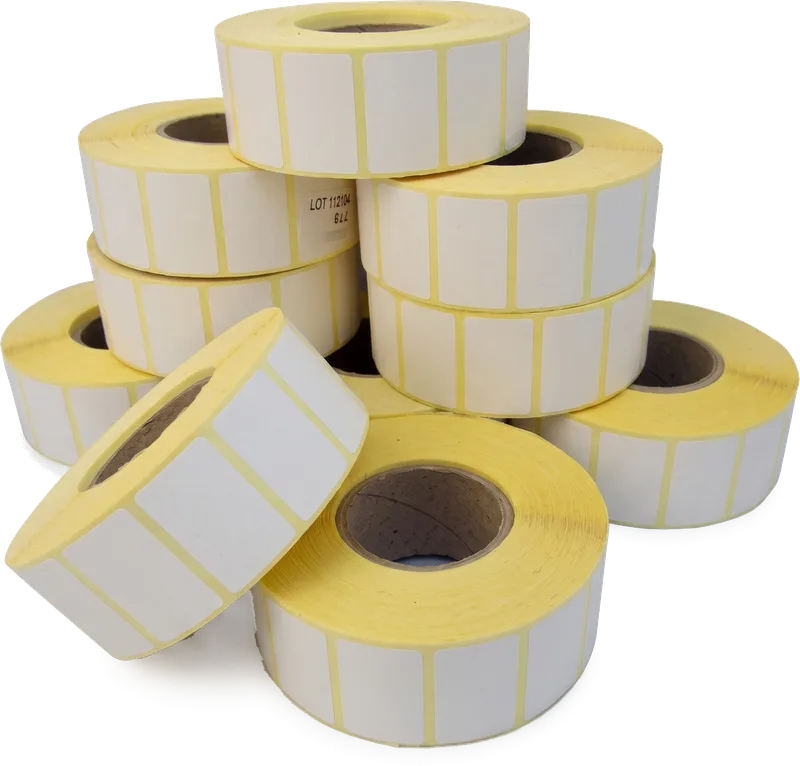
Direct thermal labels
Direct printing without a ribbon — the cheapest option, for a short cycle.
ECO and TOP (with protective topcoat)

In-house production. No middlemen. Since 2006.
We produce direct thermal, thermal-transfer, film and specialty labels, plus TTR ribbons. We match the material, adhesive and ribbon to your label's working conditions — from courier parcels, through frost and chemicals, to tyre vulcanisation — with care for compliance with industry standards.
Trusted by — manufacturers and logistics operators














We deliver the most value to companies with recurring, series demand for ready-to-print label stock on the roll — blank labels you print yourself. Below you can check whether we're a good fit.
We're the best fit for companies that:
A full wardrobe of solutions — from low-cost direct thermal to durable films and specialty labels. For every substrate we match the right ribbon and adhesive.
Direct printing without a ribbon — the cheapest option, for a short cycle.
ECO and TOP (with protective topcoat)
Durable ribbon print — resistant to abrasion, moisture and UV.
Paper and synthetic films
PP, PE, PET — water- and chemical-resistant, wide temperature range.
Cosmetics, chemicals, appliances, outdoor
Holographic, tamper-evident VOID, brittle, RFID/NFC.
Brand protection and tracking
Recycled materials (rPET) and waste-reducing solutions.
For PPWR goals / recyclability
Three ribbon classes on a price ↔ durability axis. The ink layer decides how resistant the print is — and the substrate determines the ribbon.
The cheapest, highest print speed — for paper in dry conditions.
Versatile — coated paper and matte films, better resistance.
Highest chemical and thermal resistance — for PP/PE/PET films.
Every industry has its own challenges, standards and reference customers. The laminates we use reflect the realities of end-customer applications.
Shipping labels 100×150, GS1/SSCC, legible across the whole chain.
Film + resin ribbon; matched to CLP 1272/2008 and BS 5609 requirements.
Tyre-grade adhesive resistant to vulcanisation temperatures (200–230 °C).
Food-contact materials (1935/2004); adhesives for freezing and condensation.
For serialisation (FMD) and Data Matrix codes; resistant to disinfection and autoclaving.
PP/PE films resistant to oils, a “no-label look” effect.
PET rating plates; matched to REACH/RoHS and UL 969.
Price and weigh labels, UHF RFID for stocktaking.
Not sure what to choose? First you pick the facestock by the durability you need, then the ribbon that bonds with it. Here's a summary of our selection guide.
| Label substrate | Ribbon | Temp. range | Status |
|---|---|---|---|
| Vellum paper | Wax | −5…+60 °C | ✓ resistant |
| Coated paper / semi-gloss | Wax-resin | −20…+80 °C | ✓ resistant |
| PET film (rating plates) | Resin | −40…+150 °C | ✓ resistant |
| Gloss PP film | Resin | 0…+100 °C | ✓ resistant |
| Matte PP/PE film | Wax-resin | 0…+90 °C | ~ conditional |
You're buying the certainty that the label will last the product's whole life and pass the audit — and that the process won't stall.
We control production and order dispatch — with no middleman in the chain.
We match the material + adhesive + ribbon to the label's working conditions.
We match the material and print to GHS/CLP, BS 5609, 1935/2004, FMD or UL 969 — we know what has to be on the label.
You pay the setup cost only once, and on a larger, repeat run the price per label drops markedly.
We serve customers in Poland and handle export deliveries.
A family business with a tradition since 2006.
Describe the application, material, quantity — or ask us to recommend.
We match the material, adhesive and ribbon. Quote within 24h on business days.
We send a sample to test on your own machine park.
We produce the order and ship it to you (courier or transport).
Describe the application, substrate and quantity — ideally with a plan of repeat deliveries. We'll reply with a quote within 24h on business days and show how the unit price drops at higher volumes. Order material samples to test on your own equipment.
The fastest way is by phone or email to an advisor — describe the application, material and quantity, and we'll match a solution and prepare a quote.
What to prepare for a quote
Send this information by phone or email — we'll reply with a selection and quote within 24h (business days). On request we'll prepare a free sample to test on your own equipment.